
Reconstruct Crittenden County's Former-Owner Timeline
Draft a working table before going deep. Each row should carry the transfer date, both parties, deed type, and citation, with a separate note recording how the legal description matches.
| Source | Years It Covers | Where Held | What It Shows |
|---|---|---|---|
| Current deed/index | Current; web cutoff unverified | County Clerk deed room | Newest grantee and prior grantor |
| Deed books | Collections from 1842 forward | Clerk, FamilySearch-linked catalog, KDLA | Earlier conveyances and descriptions |
| Selected deed index | Partial 1848–1900 material | Kentucky GenWeb | Name, year, book/page leads |
| Plats and encumbrance books | Series-dependent | Clerk and linked collections | Subdivision origins, mortgages, releases |
A recent chain starts at the Crittenden County Clerk. Treat historical indexes as finding aids only. Verify every hit against the actual book or image, and never force a shaky name match into your timeline.
Use the 1848–1900 Index as a Lead
The Kentucky GenWeb Crittenden deed index reproduces selected historical entries from local deed records. It reveals names, years, and citations. Book B/page 43-style citations point back to the originals. Because the index rests on a partial photocopy, search surname variants in both grantor and grantee roles, then pull the cited deed itself.
Note: Absence from the partial GenWeb index is not evidence that a Crittenden County transfer never occurred.
The captured historical deed-index page illustrates the finding aid available to former-owner researchers.
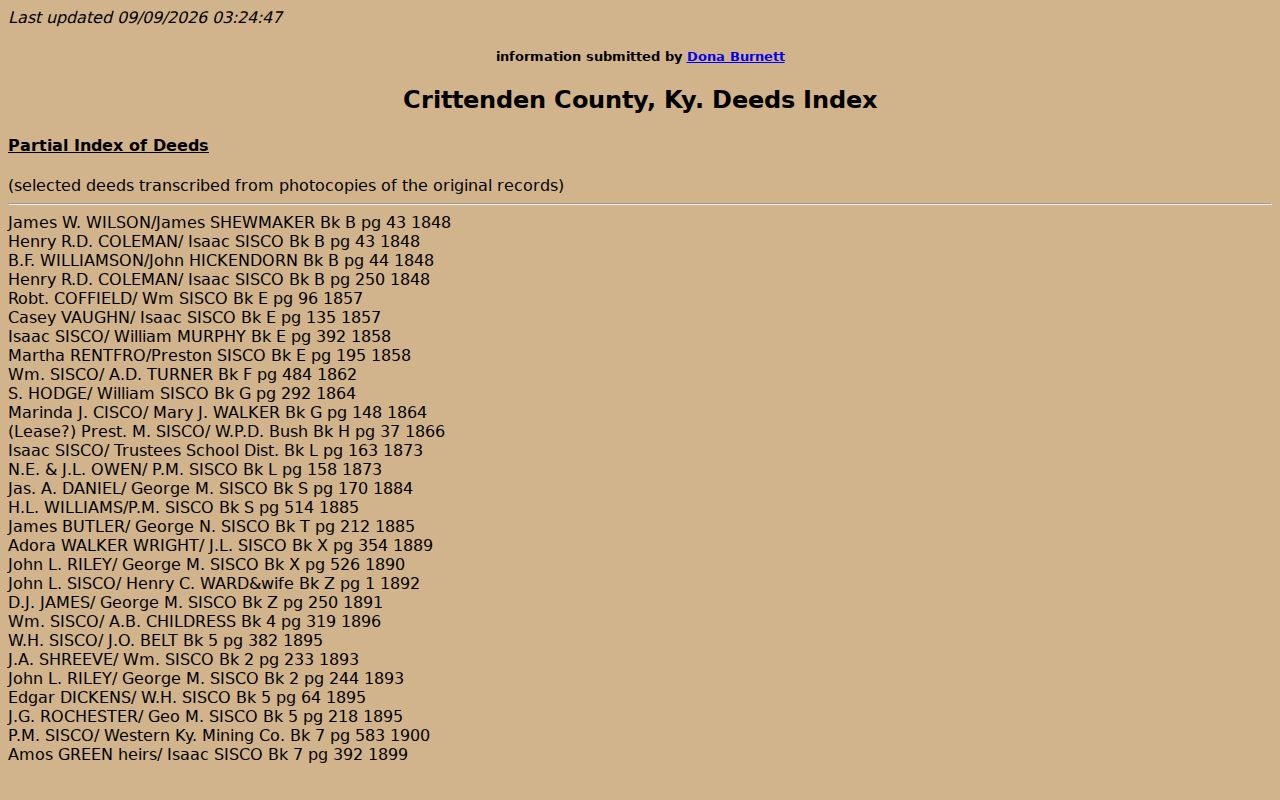
Carry every name and citation into the original deed books. A partial transcription, however convenient, never adds up to a complete ownership chain.
Continue the Chain at Marion's One-Level Deed Room
The clerk's deed room sits at 200 Industrial Drive, Suite B, in Marion, a one-level office with public research workstations. Hours run weekdays from 8:00 a.m. to 4:00 p.m. Transfers must begin 30 minutes before closing. Bring the parcel card and current owner. Include every book and page already gathered. Crittenden County publishes no complete online deed index, so phone or in-person contact is a primary route rather than a backup. Ask which general or reverse index covers your target year and where security microfilm or digital images can be viewed.
Before traveling, confirm deed-room contacts and current access on the official Crittenden County Clerk page.
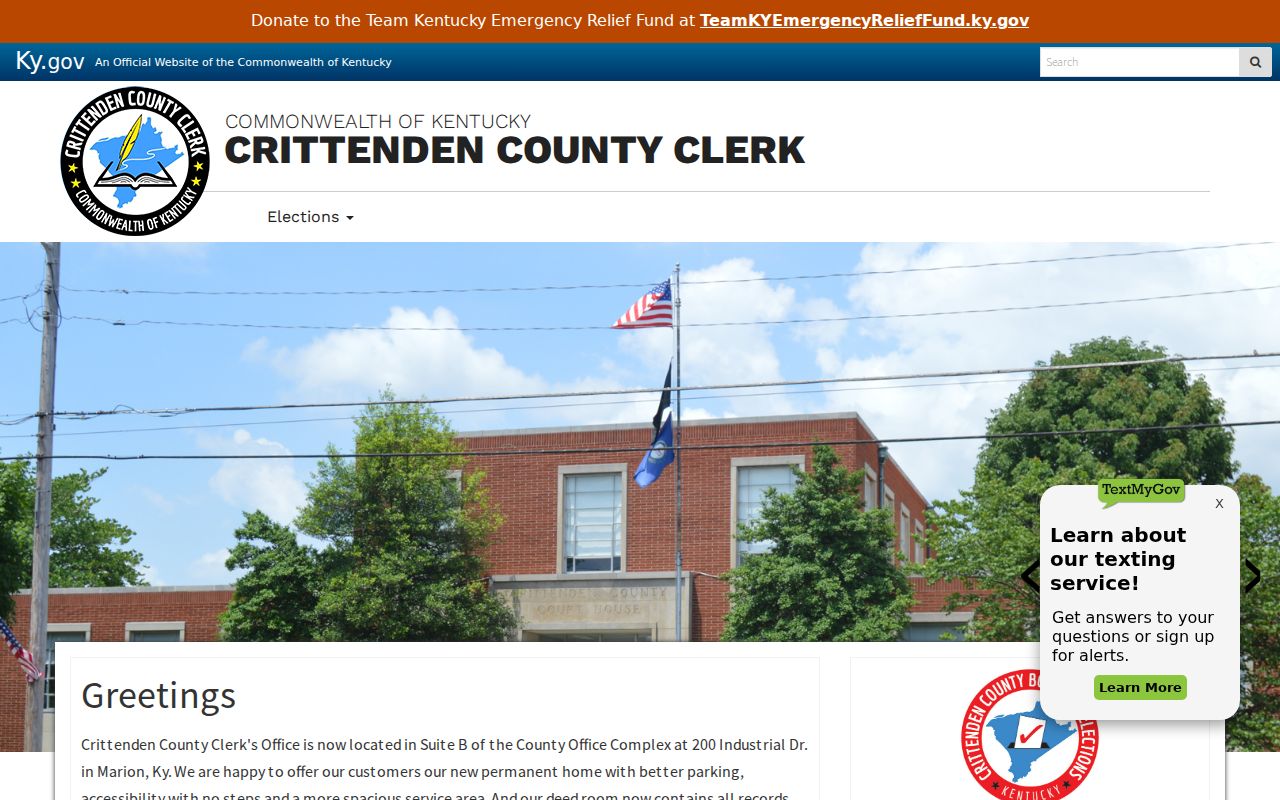
The office page anchors the in-person route, but the chain of prior owners still gets rebuilt one deed at a time.
Walk the Crittenden Deed Chain Backward
Work from a known recent deed backward. Names alone never prove ownership. At every step, confirm that the legal description matches the same tract or the parent tract it was divided from.
- Find the present owner's acquisition deed with that party listed as grantee.
- Record the grantor, transfer date, deed type, citation, and complete legal description.
- Search that grantor as a former grantee and find the instrument by which the same land was acquired.
- Repeat into the deed books, following every “same land conveyed by” citation.
- Grantor / grantee
- The conveying party and receiving party named in an instrument.
- Chain of title
- The ordered sequence of instruments affecting the same land.
- Reverse index
- An index organized to find the other party role in a conveyance.
- Quitclaim / warranty deed
- Different forms of conveyance; neither label alone proves an unbroken chain.
Go Back to Crittenden Deed Book A
The Crittenden land-record collection guide points to deed books beginning in 1842. Coverage includes 1842–1913 deed material, commissioner deeds, and encumbrance books. Access varies. The same volume may live in a FamilySearch catalog entry, an affiliate library, on microfilm, or among local originals. So note which version you used.
Historic plats can tie a later lot-and-block deed back to its parent tract. Encumbrance books add mortgage-era loans and releases. However, a mortgage party was not automatically a former fee owner.
Diagnose the 1865 and 1870 Courthouse Gaps
Marion's courthouse burned twice. Guerrillas set the January 1865 fire, reportedly destroying records, and a second courthouse burned in May 1870. A chain that vanishes near the Civil War or Reconstruction may be destroyed, not merely unindexed. That distinction shapes everything.
Rebuild cautiously from the first surviving later deed, its prior-reference clause, neighboring tracts, probate and tax material, and newspaper legal notices. The KDLA courthouse-disaster resource documents the fires. Context, however, never manufactures a missing conveyance.
Recognize Probate Transfers That Break a Sale Sequence
No buyer-seller deed may appear where you expect one. A former owner may have died. Look instead for an executor's or commissioner's deed, probate order, survivorship language, heirship evidence, or a life-estate reservation. Match the land description and case dates. A shared surname never proves succession. The Circuit Court Clerk holds case files, the County Clerk records deeds, and the recorded land instrument is what reconnects the property chain.
Understand Crittenden's Recent Preservation Work
A 2024 KDLA recommendation for Crittenden County described a $32,058.34 request. It also described a $22,838.34 recommendation covering security microfilm, digital images, and electronic indexing. The books named in the request included plat book L1329. The list also named mortgage book L1344 and power-of-attorney book L1338. It also listed 2021–2022 plats and power-of-attorney material from 1948–1973. For a county where old deeds survive mainly in bound volumes, that scope matters. Preservation work touches the same records a title researcher would handle by hand.
Scanning, quality assurance steps, and public workstations can make deed records easier to reach. The originals stay at the clerk's office in Marion. Even so, the project does not create an all-years public website for property records. Ask the clerk for the series, year, and medium available. Do not assume that a digitized book means a remotely searchable one.
Add Library and Museum Clues Without Replacing Deeds
The Crittenden County Public Library genealogy collection blends Crittenden Press microfilm, cemetery and local-history books, Ancestry access, newspapers, and family-history holdings. Obituaries can bridge an estate. So can sale notices and old place names. Lean on them when the deed chain turns ambiguous.
The Crittenden Historical Museum keeps the first courthouse bell, Marion photographs, and one-room school histories that decode older landmarks. File those finds in a context column, separate from the instruments that establish the chain.
Follow Crittenden Land When No APN Existed
A parcel number is a modern tool. Early Crittenden County deeds had none, so the land description does the identifying. Copy the survey calls exactly: watercourses, roads, monuments, bearings, distances, adjoining owners, and acreage. Capture every book and page cited too. Then hold that description against the next surviving deed. Only then link a grantor to a grantee. A shared surname or close acreage proves nothing on its own.
Platted property needs its own details. Record the subdivision, lot, block, and the plat book page where the survey lives. When a parent tract was divided, sketch how the conveyed piece sat against the retained land. Include the neighboring parcels too. Old farms often move through a chain of "same land conveyed by" recitals. Those citations, followed book to book, can trace former owners back decades before any address existed.
Watch for deeds that seem to skip past 1865 or 1870. Mark the gap. Never invent a transfer to close it. Commissioner deeds, probate orders, tax lists, encumbrance books, neighboring chains, and newspaper notices all help corroborate a chain. The first later deed that recites the older ownership may serve as the strongest bridge across the loss.
Request Older Crittenden Records Precisely
Precision pays when you request old Crittenden County material. Give the clerk names, an approximate year, the instrument type, any book and page leads, and the land description. Ask the library for a specific newspaper date range, an obituary, a legal notice, a cemetery book, or a microfilm reel. When a series sits at the state level, the KDLA records-request service is another channel worth trying.
Log every search, even the empty ones. Note spelling variants and each index role tried. A miss in one partial index does not mean the deed is missing from every book. A gap in a newspaper run does not erase the event. Good logs let another researcher repeat the chain and see exactly where its limits fall.
State Honestly How Far Crittenden Ownership Goes
Deed books survive from 1842. Still, no online index promises coverage of every later year. So searching from home has a real ceiling. The 1865 and 1870 losses can break an otherwise careful ownership chain. Older work then shifts to patents, surveys, and reconstructed descriptions. Adjoining parcels, tax records, and probate evidence help fill the gaps.
Online coverage is not the archive. Use deed books, microfilm, clerk workstations, library holdings, and KDLA requests when the web trail stops; never use former-owner data to harass a living person.
Need the current owner instead? Use the current-owner record check. To order or interpret a single instrument, continue to Crittenden County deed records.