
Read Crittenden County Property Tax Records
The PVA values and classifies parcels, while the Sheriff collects what those values produce. Treat each office's records as separate documents and compare them by parcel number and tax year rather than as one database.
| Field | What It Shows | Where |
|---|---|---|
| Land value | Assessment assigned to the land | PVA parcel card |
| Improvement value | Assessment assigned to buildings | PVA parcel card |
| Total assessment | Tax-roll value for the stated year | Certified PVA roll |
| Exemption | Statutory reduction or status if shown | PVA record and form |
| Bill and payment status | Amount collected or still due | Sheriff tax system |
| Delinquency certificate | Unpaid tax transferred to the clerk | Sheriff, clerk, and DOR process |
Kentucky law assesses real property at fair cash value. The recorded deed consideration, the PVA assessment, and a later selling price answer different questions, so preserve each field's label and effective year.
Crittenden's PVA and Sheriff Split
The Crittenden PVA maintains the certified assessment roll, owner for tax purposes, mailing and situs fields, parcel traits, exemptions, and map link. The Crittenden County Sheriff tax page handles collection and routes readers to the current Properly bill lookup.
The official Sheriff tax-information page shows the county collection route.
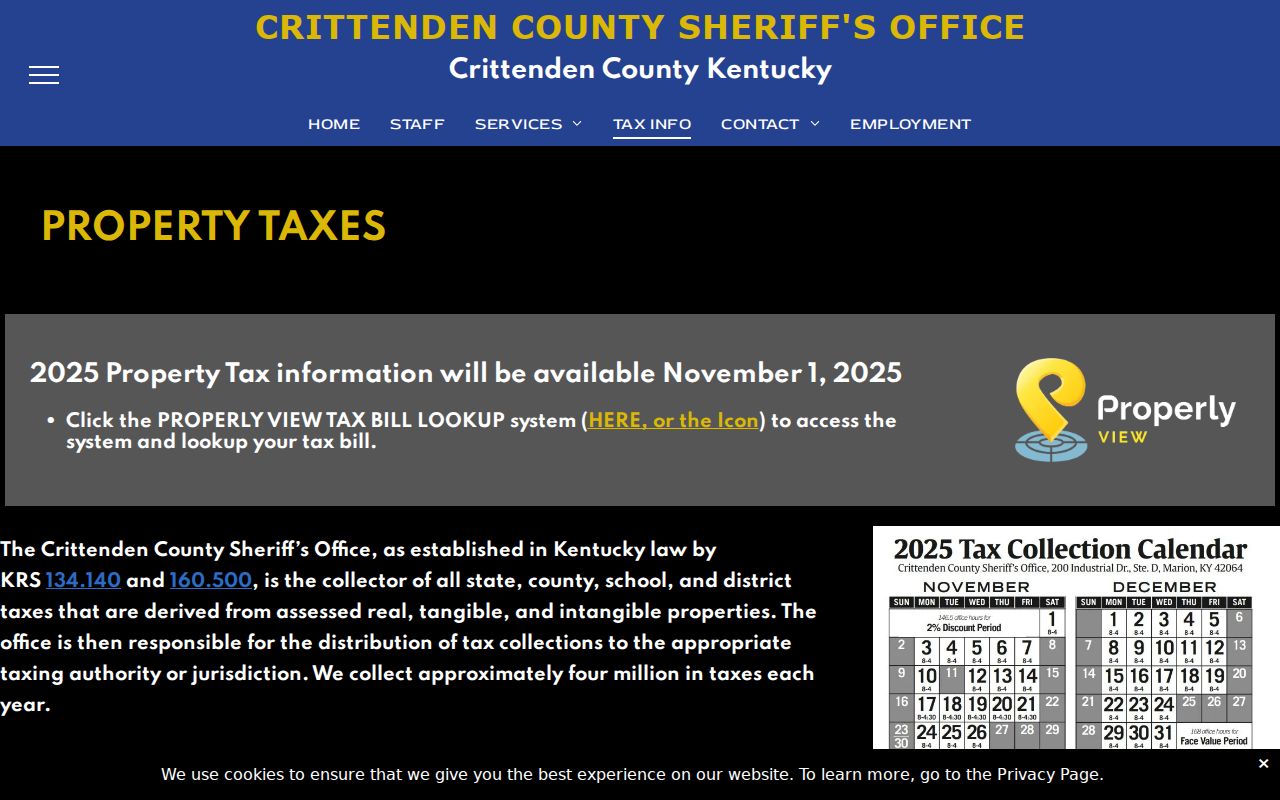
The Sheriff's tax page identifies the county collector. The live bill still controls current balances. Confirm there before paying anything. The office is at 200 Industrial Drive, Suite D, in Marion, open weekdays 8:00 a.m. to 4:00 p.m. Central at 270-965-3400. Properly's result fields can change, so verify the bill-year, balance, and payment labels you actually see before relying on them.
Why January 1 Controls Crittenden Tax Ownership
Kentucky fixes tax ownership on January 1. A deed recorded in March still leaves the former owner on that year's bill. That surprises spring buyers. The PVA tries to redirect the bill. Portal updates are not promised daily, so the roll can lag the recorder. The lag is only a timing rule. It is not proof a transfer failed, so compare the roll date against the latest recorded deed and call the Sheriff if the buyer never got a bill.
Tax-roll timing. A current Crittenden County tax bill can retain the January 1 owner after a later closing; confirm the deed separately.
Look Up a Crittenden County Tax Bill
Start with the PVA search. Address, owner, and parcel modes there help isolate the land before you carry the exact parcel number and tax year to the Sheriff's current bill link.
- Search the PVA card by address, owner, or the full map number.
- Save the assessment year, land, improvement, total, exemption, and tax owner fields.
- Open the Sheriff's tax link and match the parcel and bill year.
- Record payment or delinquency status exactly as shown and ask the Sheriff about unclear balances.
- Assessed value
- The PVA value used in tax administration.
- Tax rate or levy
- The rate applied by the relevant taxing authorities.
- Homestead exemption
- A Kentucky constitutional reduction for eligible owners who apply.
- Tax lien
- The statutory claim created by unpaid property tax.
Land, Improvements, and Crittenden Total Value
Kentucky reports land, improvements, and a total. Those components explain why a parcel card changed. New construction, demolition, an acreage correction, a reclassification, or a field review can move one line without any sale taking place. DOR requires PVA staff to physically review parcels at least once every four years. That cycle is not a countywide revaluation date. Compare cards by assessment year and confirm the current local record.
Crittenden Homestead and Exemption Records
Exemption questions and forms go through the PVA. Kentucky's homestead program is constitutional relief for eligible owner-occupants, while other statutory classifications carry different rules. A parcel card may show a flag or amount, but the current field deserves inspection rather than inference. The state homestead guidance is the official starting point.
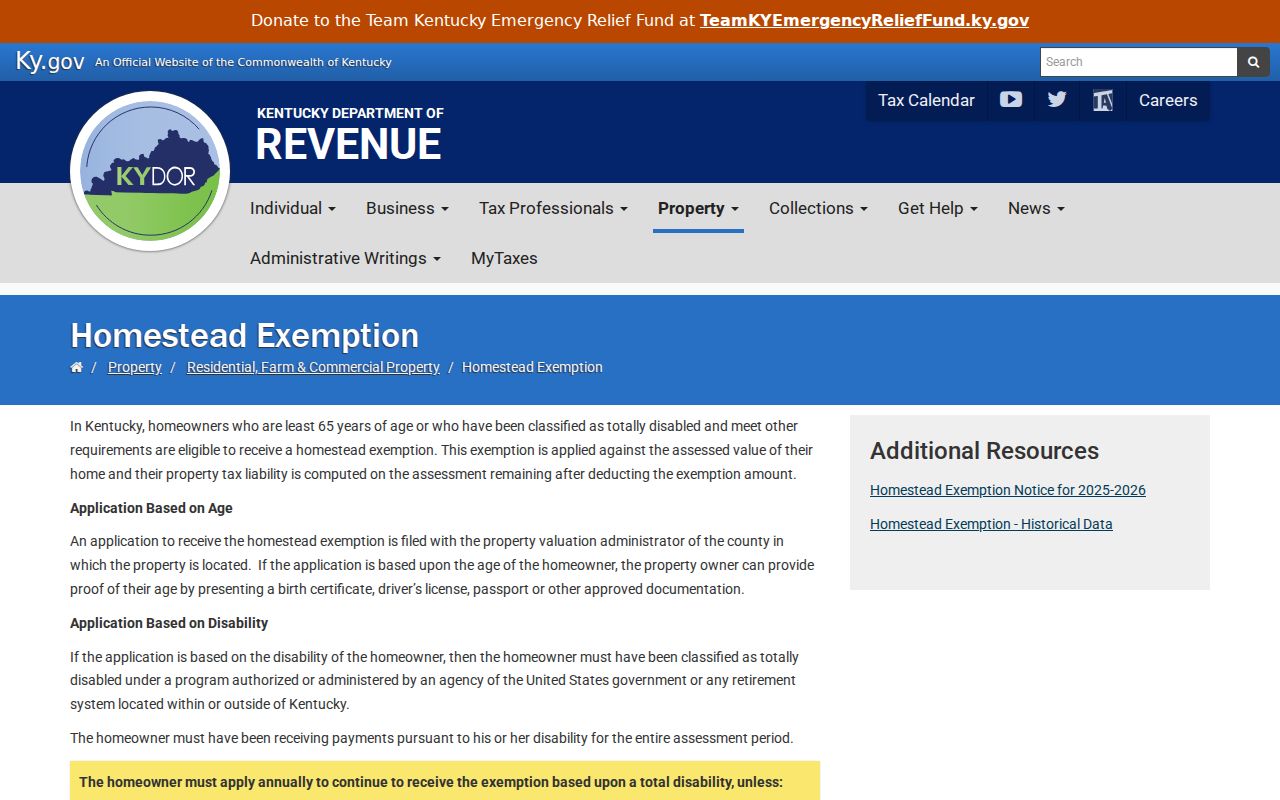
The state page lays out the program framework. The Crittenden PVA still decides local forms. Eligible parcels still need whatever local proof the PVA requires. An exemption changes taxable treatment, not the deed owner or the market evidence.
When Crittenden Taxes Become Delinquent
Unpaid Crittenden tax bills move to the County Clerk after the collection cycle. They become certificates of delinquency there. Statutory interest, fees, notice rules, and sale procedures follow. The DOR delinquent-tax guide covers the statewide route. Crittenden's 2025 registration form shows the pattern. It named a July 23 sale at 9:00 a.m. CDT and a July 14 registration deadline, and it required structured map/parcel, tax-bill, year, and prior-lien data. Treat those dates as history, not a calendar, and always replace them with the newest clerk notice.
Preserve a Crittenden Tax Search
Save the parcel number, tax year, owner label, mailing and situs addresses, district, acreage, land value, improvement value, total assessment, exemption entry, bill balance, and the date viewed. A screenshot without the year or source proves little. One local card shows why. A US 641 tract carried a blank ordinary address and a separate Fredonia mailing address. Never mix mailing destination with parcel location. Keep both fields labeled separately in any Crittenden tax search record.
How Kentucky Rates Reach a Crittenden Bill
Assessed value and the tax rate are separate parts of the bill in Crittenden County. Kentucky state and local officials set or apply rates through their assigned roles. The PVA supplies the assessment base. School, county, city, and other district components may apply according to the parcel's taxing geography. A postal city does not establish municipal tax jurisdiction. The district field and the official bill are better guides.
Always read a Crittenden bill with its year attached. Rates can change from one cycle to the next. So can exemptions, taxable bases, and land or improvement assessments. Comparing only bottom-line totals hides which factor moved. Preserve the component labels and use the Kentucky property-tax rate guidance for the statewide framework.
Keep each number in its lane. An assessment is not deed consideration. Nor is it a current appraisal. Those figures are measured on different dates for different purposes. Crittenden County property records research works best when every figure keeps its source and date. Legal meaning matters too.
Crittenden Delinquency Records Require a Date Check
Costs and parties can change once a Crittenden bill goes delinquent. The move into the certificate process brings Kentucky guidance on transfer to the County Clerk, interest and fees, required notices, installment arrangements, and the tax-sale route. A sale registration list or bidder spreadsheet identifies a tax claim at one stage. It is not proof that title changed.
The 2025 Crittenden form is unusually detailed. It separates priority and current-year registration. It also lists deposits, a lien-certificate charge, parcel and bill fields, and deadlines. Those mechanics explain the local record set, but every sale cycle needs its own current form. Before calling an encumbrance open, confirm the bill year, map number, certificate status, assignment, payment, and any later release.
Route questions to the right office. The Sheriff handles current balances and payments. The County Clerk holds assigned certificates. Litigation over a lien or foreclosure goes to the Circuit Court Clerk, keeping collection records separate from court outcomes and recorded transfers.
Crittenden Property Tax Access Beyond Portals
Vendor pages fail sometimes. Contact the Crittenden office that created the record. The PVA explains the certified roll, parcel facts, assessment components, exemptions, and the review process. The Sheriff answers bill, payment, and collection questions. The County Clerk matters after unpaid bills become certificates of delinquency.
A public-records request should name an existing item. That could be a parcel card for a map number and year. It could also be a certificate tied to one bill. Kentucky law does not require a custom database. It does not require a new tax history either. Record the retrieval date, office, year, parcel, owner, district, values, exemption, balance, and certificate references.
Assessed value and the rate are separate things. School, county, city, and district components follow taxing geography rather than a postal city. Compare Crittenden bills by year, since rates, exemptions, and values can move independently. An assessment is neither deed consideration nor an appraisal.
Kentucky DOR guidance is the fallback for roles, rates, collection, delinquency, and the annual calendar. It cannot say whether a Crittenden payment posted. Parcel questions go back to the Crittenden PVA or Sheriff. No source proves that Beacon and Properly share an update schedule.
Contest a Crittenden County Assessment
Kentucky's annual calendar starts with inspection of the tax roll. Next comes an evidence-based conference with the Crittenden PVA. If the value remains disputed, the taxpayer follows the local board process and its statutory schedule, with support like comparable sales, condition evidence, a recent appraisal, photographs, measurements, and corrected parcel facts.
Use the Kentucky property-tax calendar for the current inspection, conference, notice, and appeal sequence. Then confirm dates with the Crittenden PVA. A payment dispute belongs with the Sheriff. An assessed-value dispute starts with the PVA.
Appeal window. Crittenden County owners must act within Kentucky's seasonal conference and board calendar. Confirm the current dates before the inspection period closes.